www.thedewpointgroup.com/blog/hidden-architecture-of-work
Reading Time: 4 Minutes
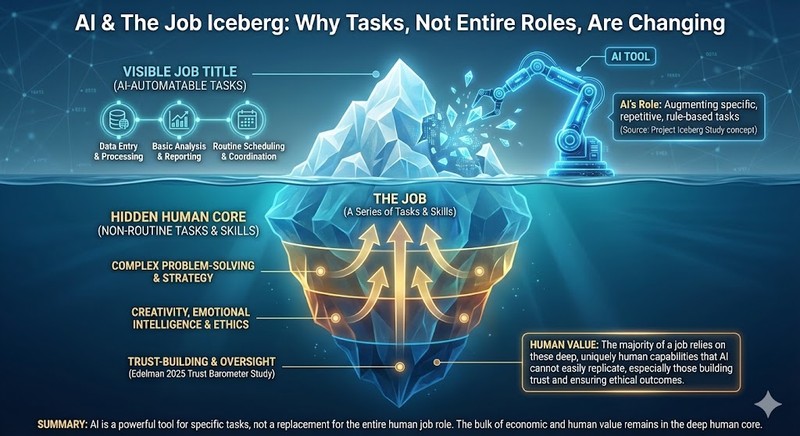
There is a fundamental misunderstanding driving the current anxiety around Artificial Intelligence. When we ask, “Will AI replace my job?”, we are asking the wrong question because we are working with an outdated definition of what a “job” actually is.
For decades, we have viewed a job role as a singular, monolithic block. You are an Accountant. You are a Marketing Manager. You are a Software Engineer.
But as the visualization above illustrates, a job is not a single block. It is a stack of distinct capabilities—some routine, some deeply complex. To understand the future of your workforce, you cannot look at the job title; you have to look at the tasks. You have to look at the iceberg.
The Visibility Trap (The 11.7%)
The “Project Iceberg” study provides a crucial lens for this moment. It suggests that while AI has high exposure to specific tasks, it has low exposure to entire jobs.
The part of the iceberg above the water represents the tasks we can see easily. These are often structured, repetitive, and rule-based: data entry, basic coding, scheduling, and routine reporting. Because these tasks are visible and high-volume, it feels like the entire job is at risk when AI automates them.
But efficiency in these tasks is no longer a competitive advantage for a human; it is the baseline for a machine.
The Submerged Value: Context and Trust
If the tip of the iceberg is about efficiency (doing things right), the submerged mass is about efficacy (doing the right things).
The vast majority of a role’s value lies beneath the surface in the “hidden human core.” This includes:
- Contextual Decision Making: AI can analyze data, but it cannot understand the political nuance of a client meeting or the emotional morale of a team.
- Complex Strategy: Navigating ambiguity where there is no historical data to train a model.
- Governance and Ethics: This is the critical frontier.
This is where the findings of the Edelman 2025 Trust Barometer become essential for every leader. As AI agents handle more execution, the premium on human trust rises. We don’t just need people to do the work; we need people to verify the work, understand its implications, and maintain the trust of stakeholders.
In an AI-augmented world, the most valuable employee is no longer the one who can process a spreadsheet the fastest. It is the one who can look at the AI’s output and say, “This is technically correct, but ethically wrong for our brand.”
The Leadership Pivot
For Mid-Market CEOs and CTOs, the challenge is not about buying technology to replace headcount. It is about redesigning workflows to account for this new reality.
If you treat AI as a replacement strategy, you will automate the tip of the iceberg and erode the foundation of trust and context that holds your business together.
However, if you treat AI as an augmentation strategy, you change the equation. You allow the machine to handle the 11.7% of tasks above the water, freeing your human talent to dedicate 100% of their energy to the strategy, creativity, and relationship-building that actually drives growth.
The future belongs to the organizations that can distinguish between the task and the role.
Build Your Roadmap with The DewPoint Group
Understanding the philosophy is the first step; implementing it is the second. At The DewPoint Group, we specialize in helping organizations navigate this shift with a focus on governance, compliance, and human-centric design.
If you are looking to audit your organization’s AI readiness or need tools to help automate the routine without sacrificing the human element, we are here to help.
Leave a Reply